SCANDINAVIAN-CANADIAN STUDIES/ÉTUDES SCANDINAVES AU
CANADA
Vol. 32 (2025) pp.1–8
DOI:10.29173/scancan274
Copyright © The Author(s), first right of publishing Scan-Can, licensed under CC-BY-NC-ND 4.0.
(Re)constructing Indigenous Linguistic Refusal Beyond the Settler Gaze: Rebecca Belmore and Jalvvi Niillas Holmberg
Authors/écrit par:
Sutherland, Charlie
Sutherland, Charlie
Statement of responsibility/Déclaration de responsabilité:
Journal Editor/Rédaction du journal:
Natalie Van Deusen, University of Alberta
Journal Editor/Rédaction du journal:
Natalie Van Deusen, University of Alberta
Statement of responsibility/Déclaration de responsabilité:
Co-editor/Corédaction du journal:
Katelin Parsons, Árni Magnússon Institute
Co-editor/Corédaction du journal:
Katelin Parsons, Árni Magnússon Institute
Statement of responsibility/Déclaration de responsabilité:
Co-editor/Corédaction du journal:
Brynjarr Þór Eyjólfsson, University of Turku
Co-editor/Corédaction du journal:
Brynjarr Þór Eyjólfsson, University of Turku
Statement of responsibility/Déclaration de responsabilité:
Production Editor/Production:
Ryan E. Johnson, University of Winnipeg
Production Editor/Production:
Ryan E. Johnson, University of Winnipeg
Statement of responsibility/Déclaration de responsabilité:
Translator/Traduction:
Malou Brouwer, University of Alberta
Translator/Traduction:
Malou Brouwer, University of Alberta
Marked up to be included in the Scandinavian-Canadian Studies Journal.
Source(s): Sutherland, Charlie. 2025. “(Re)constructing Indigenous Linguistic Refusal Beyond the Settler Gaze: Rebecca Belmore and Jalvvi Niillas Holmberg.”
Scandinavian-Canadian Studies Journal / Études scandinaves au Canada 32: 1–8.
Keywords:
- Indigenous refusal
- Indigenous Studies
- Public Art
- decolonization
- Indigenous art
- REJ: started markup December 24, 2025
(Re)constructing Indigenous Linguistic Refusal Beyond the Settler Gaze
Rebecca Belmore and Jalvvi Niillas Holmberg
Charlie Sutherland
ABSTRACT: Indigenous art, aestheticisms, and other creative expressions represent a critical
threat to settler colonial neoliberalism, working within, between, and beyond the
parameters, definitions, and conventions of the Western art world. Using the concept of
“Indigenous refusal” as a grounding framework, this article complicates the hegemonic
relationship between settler fantasy and embodied Indigenous reality, exploring the ways
that contemporary Indigenous artists Rebecca Belmore (Anishinaabe) and Jalvvi Niillas
Holmberg (Sámi) foster Indigenous futurity through their artistic engagements with the
presence and absence of language. Through a comparative analysis of Belmore’s 2013
performance piece Apparition and Holmberg’s second studio album, Luođik (2024), this paper
argues that Belmore and Holmberg’s respective works map distinct geographies of refusal,
exercising a sonic sovereignty in the service of disrupting the settler gaze. Building on
previous decolonial scholarly work on the politics of refusal, reconciliation, and
representation, this comparative approach makes obvious the thread of transnational
Indigenous solidarity that links Belmore and Holmberg’s respective works together.
RÉSUMÉ: En travaillant à l'intérieur, entre et au-delà des paramètres, des définitions et des
conventions du monde de l'art occidental, l’art, les esthétismes et les autres expressions
créatives autochtones représentent une menace critique au néolibéralisme colonial.
S’appuyant sur le concept du « refus autochtone », cet article complique la relation
hégémonique entre la fantaisie des colons et la réalité autochtone vécue et incarnée
(embodied) à travers une analyse des manières dont les artistes autochtones contemporains
Rebecca Belmore (Anishinaabe) et Jalvvi Niillas Holmberg (Sámi) facilitent la futurité
autochtone à travers leurs engagements artistiques avec la présence et l'absence de langage
et de langue. À travers une analyse comparative de la performance Apparition (2013) de
Belmore et du deuxième album studio de Holmberg, Luođik (2024), cet article soutient que les
œuvres respectives des deux artistes cartographient des géographies distinctes du refus,
exerçant une souveraineté sonore au service de la perturbation du regard de colon.
S'appuyant sur des théories décoloniaux sur les politiques de refus, de réconciliation et de
représentation, cette approche comparative met en évidence le fil de la solidarité autochtone
transnationale qui relie les œuvres respectives de Belmore et de Holmberg.
The construction and dissemination of the concept of “art” within
the settler colonial nation-state has undoubtedly functioned as a
prong of assimilationist genocide, operating along stratified
racialized and gendered lines that fundamentally devalue
Indigenous aestheticisms whilst upholding an individualistic narrative of
creative expression based in colonial concepts of ownership. Thus, the crucial
and ongoing (re)shaping of art fielded by groundbreaking contemporary
Indigenous artists through a variety of mediums and languages engages a direct
mode of defiance to settler epistemologies that view the Indigenous subject
either outside the bounds of the holistic “creative” or, when included, as
monolithic “traditional” representations of a “dying” culture curated for a
settler gaze. I assert that the work of Anishinaabekwe
performance artist
Rebecca Belmore and Sámi poet Jalvvi Niillas Holmberg strategically employ
both the absence and the presence of language in a direct act of Indigenous
refusal to the dominant settler paradigm, fostering Indigenous futurity through
an act of linguistic cultural (un)intelligibility.
For the purposes of this paper, refusal, as theorized by Kanien'kehà:ka
anthropologist Audra Simpson, will be understood as “an option for producing
and maintaining alternative structures of thought, politics and traditions away
from and in critical relationship to states” (19). Instead of recognition and the
ruse of consent it totes, Simpson (19) proposes refusal both as a political
practice and mode of analysis. Building upon Simpson’s work, Black scholar
Lindsay Stewart further separates refusal from resistance, noting that
“Resistance locks us into a life-and-death struggle with our oppressor for
recognition. In contrast, refusal withholds recognition of the oppressor’s power
or authority to define our lives” (33). Refusal thus allows for a paradigm shift
from seeking the recognition of the oppressor to the struggle for self-definition
within one’s own culture, identity, and community (Stewart 33).
Rebecca Belmore (b. 1960) is an Anishinaabe multidisciplinary artist who
specializes in the medium of performance, particularly focusing on the inherent
sociopolitical interrelationality between Indigenous bodies, land, and language
within the imperial core, and the intricacies of place and identity (“Biography”
par. 2). A member of the Obishikokaan (Lac Seul) First Nation, Belmore was born
and raised in what is now called “Upsala, Ontario” in Treaty 3 Territory (Berlin
par. 2). Belmore is arguably one of the most well-known performance artists in
the contemporary imaginary, with accolades including the Jack and Doris
Shadbolt Foundation’s VIVA Award (2004), the Hnatyshyn Visual Arts Award
(2009), the Governor General’s Award in Visual and Media Arts (2013), the
Gershon Iskowitz Prize (2016), and has been the recipient of three honorary
doctorates from the Ontario College of Art and Design University (2005), Emily
Carr University of Art + Design (2018) and the Nova Scotia College of Art and
Design University (2019) (“Biography” par. 4). As the first Indigenous woman to
represent “Canada” at the Venice Biennale in 2005 (Berlin par. 2), Belmore has
become a critical driving force in disseminating, (re)shaping and refuting global
perspectives of Indigeneity and Indigenous art, with past exhibitions in Greece,
Germany, Italy and Cuba (“Biography” par. 3).
Despite operating within vastly different mediums, Sámi poet, filmmaker
and musician Jalvvi Niillas Holmberg similarly challenges Western,
individualistic conventions of “art” through multidisciplinary creative work
that actively defies the dominant settler paradigm. Born 1990 in Ohcejohka
(“Utsjoki”) on the “Finnish” side of Sápmi, Holmberg’s art, written and
performed primarily in his mother tongue of North Sámi, occupies and
describes a liminal space shaped by complex explorations of identity, linguistic
and cultural translation, land-based knowledge and anti-colonial
epistemologies, all inherently grounded within a Sámi understanding of place
and tradition (Prusynski 19). Albeit relatively removed from the public eye,
Holmberg’s art has reached international critical acclaim. Holmberg’s works
have been translated into Estonian, French, German, Norwegian, Finnish,
Spanish and English and performed globally, earning him numerous awards,
including the Eino Leino Literature Prize (2023), the Art Prize of the Lapland
Regional Fund (2021), the Premio Giovani Literature Prize (2015), the Saami
Council Literature Prize (2014), a winning spot in the Sámi Grand Prix (2005),
Sámi of the Year (2016), two separate nominations for the Nordic Council
Literature Prize (2015 & 2020, respectively), and an Honorary Doctorate of Arts
from Lapin yliopisto (2024) (“Jalvvi Niillas – Niillas Holmberg” par. 6). Active in
larger Sámi creative spheres since 2009 (Prusynski 19), Holmberg remains
dedicated to decolonial, anti-capitalist activism, particularly focused on
documenting and disrupting extraction occurring in traditional Sámi areas like
Deatnu, Fovsen Njaarke, Aanaar and Gállok (“Jalvvi Niillas Holmberg” par. 3).
This activist epistemology inherently structures his creative endeavors—as
Holmberg’s biography notes, “Land-based knowledge and anti-colonial aspects
are at the heart of his work” (“Jalvvi Niillas Holmberg” par. 3).
Belmore weaves a similar thread of radical decoloniality throughout all
elements of her work, a theme most poignantly highlighted through her pieces
exploring the ongoing, intergenerational trauma of residential schools and the
hegemonic politics of reconciliation. Directly exemplifying this focus is
Belmore’s 2013 piece Apparition, a looping video installation displayed at the
Morris and Helen Belkin Art Gallery for their exhibit Witnesses: Art and Canada’s
Indian Residential Schools (Gaertner 13). Roughly four minutes in length,
Apparition opens with a slow fade to Belmore kneeling in front of a blue
background, duct tape covering her mouth whilst she vacantly stares down the
barrel of the lens (Gaertner 13). Her empty gaze appears to look through the
spectator, a constant, haunting presence until Belmore moves from a praying
position to a cross-legged position, slowly ripping the duct tape from her mouth
(Gaertner 13). Upon removing the tape, Belmore breaks her vacant stare,
moving out of frame, before the clip begins to loop again (Gaertner 13).
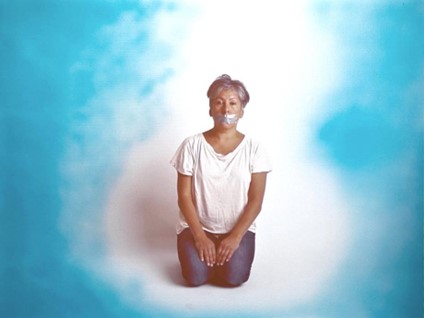
A snapshot of Apparition, in lieu of the video clip.
Credit: Leif Norman / Morris and Helen Belkin Art Gallery / 2013.
Whilst Apparition itself is a piece reflecting upon the profound loss of
language through the genocidal apparatus of residential schools, as reflected by
Belmore in her artist statement, what I wish to specifically highlight is her
embodied use of silence and the absence of language to engage in a direct act of
Indigenous refusal. In remaining silent after the duct tape has been removed,
Belmore actively refuses to reproduce a testimony, thus subverting the dialectic
of testimony/apology that shapes settler/Survivor interactions within a politic
of reconciliation (Gaertner 14). The customary logic of “forgiveness” embedded
within contemporary state-sanctioned reconciliation is wholly removed, thus
forcing a settler audience to contend with their own culpability and
uncomfortability in ongoing assimilationist colonial genocide.
Moreover, through such an absence of language, Belmore refuses to allow
her body to become the “bridge” (Anzaldúa and Moraga xxxvii) between settler
audiences and her lived experiences of Indigenous womanhood: she refutes
what xwélmexw (Stó:lō) scholar Dylan Robinson (96) calls “xwelítem
hunger,”
the consumptive desire of settlers to devour knowledge. Belmore thus combats
settler ideations of knowledge, testimony, and depletion as ownable,
consumable commodities by exposing the population of the settler state to an
environment wherein knowledge, through a state of absence, is rendered
inaccessible. In refusing to reproduce the language of the colonizer, Belmore
enacts a sovereign space in which her identity and personhood remains
unintelligible within a settler epistemology, a space wherein her Indigeneity
exists in direct defiance to a colonized practice of “reconciliation” shaped by a
politic of hegemonic, white respectability.
Furthermore, it is crucial to note that when discussing Belmore’s
performance pieces, as I do with Apparition, I do not use the language of
“absence” to signify deficit—instead, I assert that Belmore’s silence maps a
geography of refusal, an active practice that examines the power in what is left
unspoken, but not unsaid. As local curator and author Glenn Alteen notes in the
foreword to Wordless: The Performance Art of Rebecca Belmore (2019), Belmore
“use[s] her body to ‘speak’ without language...going beyond language, Belmore
wrestles meaning out of thin air” (4). Belmore’s practice of silence, then, is both
deeply laden with meaning and an inherent act of refusal: Belmore refuses to
be understood within a linguistically colonial cosmology, echoing Stewart (33)
in withholding a recognition of colonial power and refuting its ability to define
the parameters of Indigenous life. Shirking the inherent coloniality of English
as a medium of expression, Belmore instead communicates meaning through
active silence, utilizing her body as a vessel to transmit an ongoing praxis of
refusal.
Holmberg, directly echoing Belmore’s storied tapestry of refusal, weaves a
similar thread of resilience through his 2024 studio album Luođik, produced by
Sámi sound designer Pekka Aiko and published by DAT, a Sámi publishing house
located in Sápmi (“Music” par. 1). On his website, Holmberg describes Luođik as
a “yoik-soundscape album recorded on a Deatnu river boat. Jalvvi Niillas
Holmberg rows the boat while reminiscing his ancestors and their relatives
through luohti - yoik” (“Music” par. 1), thus grounding Luođik in a “Sámi
cultural context, and specifically in a Sámi understanding of space and a
tradition of Sámi writing about space” (Prusynski 21). Through Luođik’s
sovereign soundscape, Holmberg, like Belmore, maps a geography of refusal,
actively utilizing the presence of a distinctly Sámi language and means of being
on, with, and part of land to invert the subjugator-subjugated relationship,
thereby constructing the settler body as the ostracized Other, unable and
prohibited from fully comprehending the profundity of Holmberg’s linguistic,
place-based refusal.
This refusal, forged through a culturally (un)intelligible, untranslated
linguistic space, directly refutes what Robinson (85) calls the colonial lang-scape—relationships
of displacement and hostility to place and land, structured
through colonial language and the extractivist epistemologies that accompany
it—by privileging an inherently Sámi mode of being. In refusing to provide a
translation or milieu, Holmberg, like Belmore, combats the consumptive desire
of a xwelítem audience, thus embodying a space made both by and for Indigenous
Peoples: Luođik (re)centres oral histories and performance as crucial ways of
knowing and learning that enforce the validity of traditional Indigenous
epistemologies. Utilizing his exclusively Sámi lyricism and expression through
yoik, Holmberg simultaneously speaks to both his ancestors and descendents,
daring to envision a future of fluent Sámi speakers: Holmberg’s refusal, then, is
a message of survivance to generations past, present, and future. Here, a
linguistically sovereign space is established through an active rejection of the
language of the colonizer, refusing colonial vanishing narratives of language
“endangerment” that datify Indigenous life, instead asserting the continuous
resilience, presence, and vitality of extant Indigeneity.
In situating Indigenous life, art, and expression within a contemporary
context, Holmberg further challenges the so-called juxtaposition of the
“traditional”/“modern” binary implicit in Luođik’s production, refusing a
stereotypical, one-dimensional and dehumanizing portrayal of Indigenous
Peoples as the last vestiges of “traditionalistic,” “dying” cultures by directly
(re)shaping the very concepts of “traditionality” and “authenticity”
themselves. Playing with the assumed “traditionality” of the yoik, Holmberg
refutes a settler hunger for “authenticity” by placing yoik within the larger,
“modern” context of a mass-produced commercial album available to global
audiences on the largest streaming platforms. This cultural hybridity is
imperative in (re)contextualizing and (re)defining Indigeneity within an
increasingly globalized world, (re)constituting representations of Indigenous
lived experiences and settler understandings of “traditional” practices as living,
evolving, and adapting alongside contemporary Indigenous temporalities.
Destabilizing a colonial politics of recognition by directly nurturing a space
for Indigenous joy and pride in identity, Holmberg employs agency in his refusal
to “play the white man’s game” (Stewart 35), a mode of being that reduces
Indigenous life to a constant struggle against settler encroachment, land theft,
and violence—instead, Holmberg privileges a journey of self-determination and
self-definition outside these settler paradigms, a praxis of refusal that
challenges the limits of “change” within a colonial system by semantically
refuting the presence and participation of the created settler Other.
Whilst Belmore and Holmberg operate within and between widely different
mediums, utilizing unique, place-based knowledge that firmly roots their work
in distinctly Anishnaabe and Sámi temporalities, both chart a poetic of refusal,
“refus[ing] to refuse” (Aparna and Hamzah 227) on the colonizer’s terms. To
weaponize the false dichotomy of linguistic absence/presence in Belmore and
Holmberg’s pieces is to smother the intimate throughline of refusal that
connects their work across space and time, manufacturing difference to
constrain geographies of transnational Indigenous solidarity. Refusing a
colonial politic of “respectability,” Belmore and Holmberg actively challenge
the settler consciousness, refusing to reproduce the language, testimony, and
expectation of the oppressor, instead situating their own embodiments of
identity and Indigeneity outside a colonial, sociolinguistic boundary.
NOTES
- Roughly translates to “Anishinaabe woman.”
- A term used to describe settlers in upriver Halq’eméylem, although it more accurately translates to “starving person” (Robinson).
- I think it is similarly crucial to acknowledge here that this nuance is not something I, as a non-Indigenous, and more specifically, non-Sámi person would ever claim to understand. Situating my positionality as a white settler is key in contextualizing my analysis here, and while I comment on Holmberg’s mode of delivery, the full impact of his work is, as it is with all other non-Sámi folks, inaccessible to me.
REFERENCES
- Alteen, Glenn. “Foreword by Glenn Alteen.” In Wordless: The Performance Art of Rebecca Belmore, 4–5. Information Office, 2019.
- Aparna, Kolar, and Saba Hamzah. “Languaging as Refusal.” FENNIA - International Journal of Geography 201, no. 2 (2023): 215–28. https://doi.org/10.11143/fennia.122372.
- Anzaldúa, Gloria E. and Cherríe Moraga. This Bridge Called My Back: Writings by Radical Women of Color. Watertown, Massachusetts: Persephone Press, 1981.
- Berlin, Mira. “Rebecca Belmore.” The Canadian Encyclopedia, February 7, 2014. Accessed November 15, 2024. https://www.thecanadianencyclopedia.ca/en/article/rebecca-belmore.
- “Biography.” Rebecca Belmore. Accessed November 15, 2024. https://www.rebeccabelmore.com/bio/.
- David Gaertner. The Theatre of Regret: Literature, Art, and the Politics of Reconciliation in Canada. Vancouver: University of British Columbia Press, 2020.
- “Jalvvi Niillas Holmberg.” Jalvvi Niillas Holmberg. Accessed November 15, 2024. https://niillas.com/.
- "Jalvvi Niillas – Niillas Holmberg." Jallvi Niillas Holmberg. Accessed December 30, 2025. https://niillas.com/s/BIOCV-NHolmberg-eng-t3pc.pdf
- “Music.” Jalvvi Niillas Holmberg. Accessed November 15, 2024. https://niillas.com/music.
- Norman, Leif. Apparition. 2013. Photograph, 148 × 110 px. Morris and Helen Belkin Art Gallery.
- Prusynski, John. 2024. “International Travelers after Valkeapää: Aikio and Holmberg.” PhD diss (unpublished). University of California, Berkeley.
- Robinson, Dylan. “Public Writing, Sovereign Reading: Indigenous Language Art in Public Space.” Art Journal 76, no. 2 (2017): 85–99. https://doi.org/10.1080/00043249.2017.1367195.
- Simpson, Audra. “The Ruse of Consent and the Anatomy of ‘Refusal’: Cases from Indigenous North America and Australia.” Postcolonial Studies 20, no. 1 (2017): 18–33. https://doi.org/10.1080/13688790.2017.1334283.
- Stewart, Lindsey. The Politics of Black Joy: Zora Neale Hurston and Neo-Abolitionism. Evanston, Illinois: Northwestern University Press, 2021.